Right then. Let’s address the elephant in the room.
You bought the ChomChom. You’d heard the rumours—saw the videos of fur vanishing as if by magic—and you thought, “Finally, the solution to my hairy sofa situation.” You got it home, gave it a long, elegant sweep across the cushion, and… nothing.
It pushed the hair around a bit. Maybe picked up a stray fluff. But mostly, it was a disappointment.
So now it’s sitting in a drawer.
Here is the hard truth: The product isn’t broken. Your technique is.
About 30% of people treat this tool like a standard sticky tape roller or a lint brush. But it isn’t one. It’s a mechanical device that relies on static electricity and friction. And if you don’t give it the friction it demands, it won’t give you the clean sofa you deserve.
Here is how to stop wasting your time and start actually removing the hair.
The Science Bit (Briefly)
Sticky rollers work by adhesion. Glue grabs hair. Simple.
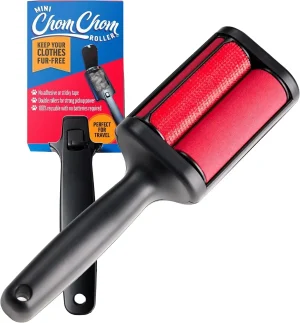
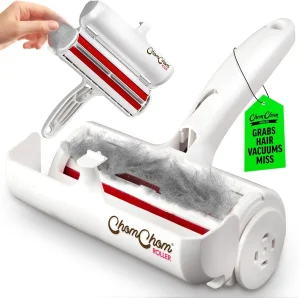
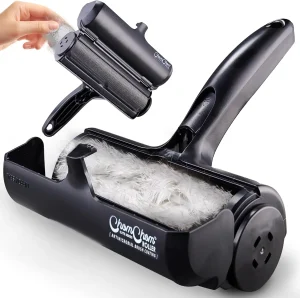
The ChomChom, however, uses a static charge generated by two opposing bristle bars. When you move it correctly, an internal rubber blade flicks the hair into the back compartment. If you move it slowly or in one direction, that blade never flips. No flip, no clean.
The Golden Rule: The “Back and Forth”
If you take nothing else from this guide, take this: Stop the long, sweeping strokes.
To make this work, you need to be aggressive. Not angry—just firm.
- Place the roller on the fabric.
- Scrub it. Move your hand back and forth in short, sharp movements. We’re talking 10 to 15 centimetres, tops.
- Listen for the noise. If it’s silent, you’re doing it wrong. You want to hear a rhythmic clack-clack-clack. That sound is the internal brush flipping directions and trapping the hair.
Think of it less like painting a wall and more like scrubbing a stain out of a carpet. Short. Sharp. Vigorous.
Top Tip: If your arm isn’t getting a slight workout, you aren’t generating enough static.
Best Surfaces: Where It Shines
This tool isn’t magic; it’s physics. It needs a surface that provides tension. If the fabric is too loose or smooth, the rollers simply slide without generating a charge.
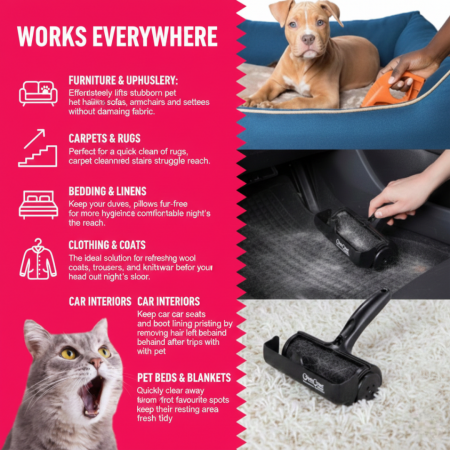
- Sofas and Armchairs: Specifically velvet, chenille, or tough woven fabrics. These are the natural habitat of the ChomChom.
- Bed Linen: Cotton sheets and duvet covers provide excellent drag. Hold the sheet taut with one hand and roll with the other.
- Carpets: Ideal for short-pile rugs or the stairs. It won’t replace your vacuum, but for a quick tidy before guests arrive, it’s spot on.
- Car Interiors: Perfect for those fabric seats that seem to weave dog hair into the actual fibre.
Where NOT to Use It (The “Don’t Bother” List)
Save yourself the frustration. The roller will fail on these surfaces:
- Leather or Faux Leather: It will just slide. Zero friction means zero static. You’re better off with a damp cloth.
- Hard Floors: Wood, tile, or laminate. It’ll just make a racket and scratch the floor. Use a broom.
- Loose Knits and Clothing: Be very careful here. On a tight denim jacket? Fine. On your favourite wool jumper or a loose-knit blanket? The bristles can snag the loops and ruin the garment.
Cleaning the Beast
Once you’ve mastered the “wiggle” technique, you’ll find the roller stops picking up. This means the trap is full.
Don’t try to pick the hair out of the bristles manually. That’s a mug’s game.
- Find the small button on the handle.
- Press it to pop the back chamber open.
- Empty the grey felt sausage of hair into the bin.
If the red bristles look a bit grubby after a few months, don’t wash it under the tap. Water kills the mechanism (metal springs inside often rust). Just wipe the bristles with a damp cloth and let it air dry.
The Verdict
If yours is “not working,” change your stroke. Shorten it. Speed it up. Make it click. Once you get the rhythm, it’s arguably the most satisfying gadget you’ll own.
Still struggling? Watch the motion in action below.
Need a second one for the car?
Surface-by-Surface Pressure Guide
The ChomChom is not a one-pressure-fits-all tool. Different surfaces respond differently, and knowing how much force to apply for each is the difference between a good result and a great one.
- Short-pile sofa fabric (polyester, microfibre): Firm pressure, fast back-and-forth strokes. This is where the ChomChom is most aggressive and most effective. Do not be timid.
- Velvet upholstery: Medium pressure, slower strokes, rolling in the direction of the nap. Too much speed can temporarily flatten the pile.
- Car carpet: Firm pressure, work in small sections. Car carpet tends to have a very tight pile — you may need to make several passes before the embedded hair is fully freed.
- Pet beds (canvas or nylon exterior): Firm pressure. Pet beds are the highest-dander-concentration surface in most homes — do not be gentle here.
- Clothing (woollen coats, fleece): Light-to-medium pressure. The fabric moves on your body, so lay the garment flat before rolling. Roll with the grain of the fabric, not against it.
- Curtains: Light pressure with slow, deliberate strokes moving downward with the fabric weight. Support the curtain with your other hand so the fabric does not bunch.
UK-Specific Tips: Managing the Spring Moult
The UK spring moult — typically February through April — is when British pet owners feel the ChomChom's value most acutely. The Kennel Club UK notes that Britain’s most popular breeds — Labradors, Golden Retrievers, Cocker Spaniels — are heavy seasonal shedders, making effective tools essential during moult months. During this period, dogs and double-coated cats drop their winter undercoat in volume that can feel almost alarming. A few practical adjustments for moult season:
- Empty the collection chamber more frequently — after every session during peak moult. An overfull chamber means the roller begins depositing hair back on the surface rather than collecting it.
- Work in smaller, overlapping sections rather than long sweeping strokes. The density of loose fur during moult means the roller fills faster, and shorter sections ensure thorough collection before the chamber is overwhelmed.
- For very heavy accumulation (think a Golden Retriever or Husky on a fabric sofa), consider a preliminary pass with a rubber glove to bulk-remove the loose top layer before the ChomChom addresses the embedded fur beneath.
Combining the ChomChom with Other Tools
The ChomChom is excellent at what it does — but it is not the only tool worth having. Here is how it fits into an effective overall pet hair management system:
- ChomChom + vacuum: The correct order is always ChomChom first, then vacuum. The roller frees embedded hair that the vacuum then collects. Using the vacuum first and the ChomChom second wastes the roller's ability to dislodge hair that suction cannot reach.
- ChomChom + deshedding brush (Furminator): Address the source (the dog) before the sofa. Weekly deshedding outdoors with a Furminator dramatically reduces how much fur reaches your furniture in the first place.
- ChomChom + rubber glove: For very stubborn embedded fur on car carpet or tight upholstery, a damp rubber glove used in a circular motion loosens the hair mechanically before the ChomChom collects it. Especially useful in winter when static is reduced by humidity.
The most effective UK pet owners are not those who have found the single perfect tool — they are those who understand the right tool for each stage of the job. The ChomChom sits at the centre of that system as the most versatile and effective daily-use solution available.
Frequently Asked Questions
How do I use the ChomChom Roller correctly?
The correct technique is a firm back-and-forth scrubbing motion — not a one-direction roll like a sticky roller or paint roller. The back-and-forth motion is what generates the static electricity that lifts hair from fabric fibres and the friction that agitates embedded fur loose. Apply firm, even pressure and work in sections of about 30cm at a time, overlapping each pass.
Why is my ChomChom Roller not picking up any hair?
The most common mistake is rolling in only one direction, which does not generate sufficient static or friction. The ChomChom requires a back-and-forth scrubbing motion. The second most common cause is a full or partially blocked collection chamber — empty it completely and clean the velour strips with a dry brush, then try again. Performance should be restored immediately.
What surfaces can I use the ChomChom Roller on?
The ChomChom Roller works best on upholstered sofas, armchairs, car seats, carpet mats, pet beds, clothing, and curtains. It is most effective on tight-weave fabrics where hair is embedded rather than just sitting on the surface. Avoid very loose open-knit fabrics, lace, and delicate silk — these benefit from a traditional tape roller instead.
Common Mistakes and How to Avoid Them
Even experienced ChomChom users occasionally fall into habits that reduce the roller's effectiveness. Here are the most common technique mistakes and the simple corrections:
- Rolling in one direction only: The most common error. The ChomChom is not a sticky roller — uni-directional rolling does not generate the static charge or friction that makes it work. Always back-and-forth.
- Too little pressure: People who are cautious about damaging their sofa often use insufficient pressure. For robust fabrics, firm contact is not just safe — it is necessary for the micro-bristles to engage with embedded fur in the weave.
- Covering too large an area per pass: Long sweeping strokes across an entire sofa cushion collect surface fur adequately but miss deeply embedded hair. Working in 20–30cm sections, overlapping each pass slightly, produces a more thorough result.
- Not emptying the chamber frequently enough: An overfull chamber means fur collected on the velour strips cannot be directed into the storage space — so the roller starts redepositing fur rather than collecting it. Empty after every major surface during heavy shedding season.
- Using it after the vacuum rather than before: Vacuuming first does not improve ChomChom performance — it wastes the roller's ability to agitate embedded hair that the vacuum missed. Always ChomChom first, then vacuum to collect what has been freed.
Getting Children and Other Household Members Involved
In many UK households, the ChomChom is used almost exclusively by one person — the primary home manager — while other family members leave fur accumulation unchecked between sessions. Getting the whole household to participate in quick daily rolls is far more effective than one person doing a thorough session weekly.
The ChomChom is genuinely easy for children aged 8 and over to use safely — there are no sharp edges, no chemicals, no risk of damage to themselves or the furniture if used correctly. The collection chamber provides immediate visual feedback ("look how much fur came off the sofa!") that children often find satisfying. Making it part of a simple household routine — roll your sitting spot on the sofa before you sit down — can dramatically reduce overall fur accumulation with minimal effort from any individual family member.
The cumulative effect of five people each doing a thirty-second roll of their sofa section every day is equivalent to one person doing a thorough session every day — but distributed in a way that requires almost no effort from anyone individually. This is the most sustainable approach to pet hair management for busy UK households.
Further Reading