Hidden Allergens: Why Your Vacuum Cleaner Is Missing 40% of Pet Dander
You have vacuumed the carpet. You have plumped the cushions. The house looks immaculate.
You sit down with a cup of tea, and five minutes later, your eyes start to water. Then comes the sneeze.
It is one of the most frustrating aspects of pet ownership. You can clean until you are blue in the face, but the allergies persist. Why? Because you are focusing on the hair you can see, while ignoring the dander you can’t.
And unfortunately, your vacuum cleaner might be part of the problem.
The Difference Between Hair and Dander
Let’s get technical for a moment.
The fur on your sofa is annoying, but it isn’t usually the allergen. The allergen is a protein found in the animal’s saliva and skin cells (dander). These microscopic particles attach themselves to the hair.
When the hair falls out, it acts as a transport system, delivering these allergens deep into the weave of your furniture.
The Vacuum Paradox & The Static Solution
When you use a standard vacuum cleaner, it relies on airflow. It sucks air in, filters it, and blows it out the back.
Unless you have a high-end machine with a medical-grade HEPA filter, that exhaust air often blasts microscopic dust and dander back into the room before you’ve even finished cleaning. You are essentially stirring the pot.
This is where the ChomChom is different.
It doesn’t use air. It uses static electricity.
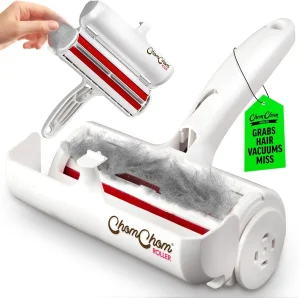
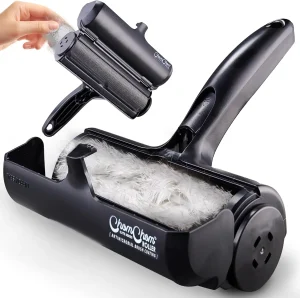
When you create that friction with the back-and-forth motion, you aren’t just grabbing the hair. The static charge acts like a magnet for micro-particles. It traps the dander inside the chamber rather than launching it into the air you breathe. It captures the dust, rather than displacing it.
The Allergy Sufferer’s Cleaning Protocol
If you are tired of living on antihistamines, change your cleaning order. Most people do it backwards.
Here is the correct protocol:
- The Static Sweep (ChomChom): Go over the sofa and curtains first. This traps the heavy hair and the dander clinging to it without creating a dust cloud.
- The Damp Wipe: Once the hair is gone, wipe hard surfaces with a damp microfibre cloth. This catches any settled dust.
- The Floor: Vacuum the floor last.
By removing the source on the furniture before you introduce airflow or wet cloths, you stop the allergens from circulating.
The Verdict
We have customers who tell us they thought they were allergic to their cats, only to realise they were just allergic to their own sofa.
You don’t need to ban the dog from the living room. You just need to remove the evidence properly.
Dreathe freely again. It’s cheaper than air purifiers.
Pet Allergies in the UK: A Widespread Problem
Pet allergies are among the most common household allergies in Britain. Allergy UK estimates that around 30–40% of people with asthma have an allergic reaction to cats or dogs. The primary trigger is not fur itself but a specific protein — Fel d 1 in cats and Can f 1 in dogs — found in pet skin cells (dander), saliva, and urine.
What makes dander particularly difficult to manage is its size. A single dander particle can be as small as 2.5 microns — small enough to remain airborne for hours after disturbance. This is why people with pet allergies often react not when near the pet, but when they sit on a recently vacuumed sofa or walk into a room where the pet has been all day.
Where Dander Hides in a Typical UK Home
Understanding where dander accumulates helps you build a more effective cleaning routine. These are the highest-concentration areas in most UK homes:
- Upholstered sofas and armchairs: The number one dander reservoir. Pets rest here, and the fabric holds millions of microscopic particles in its fibres.
- Carpets and rugs: Particularly deep-pile rugs or traditional UK wool carpets, which trap dander between fibres.
- Curtains and drapes: Often overlooked. Dander floats through the air and settles on hanging fabrics at every height.
- Bedding: If your pet sleeps on the bed — or even enters the bedroom — dander levels in bedding can be extremely high.
- Car interiors: Upholstered seats trap dander the same way sofas do. Important for allergy sufferers who travel with pets.
The Room-by-Room Cleaning Protocol for UK Allergy Sufferers
A systematic approach, rather than ad-hoc cleaning, is far more effective at keeping dander levels low. Here is a practical protocol for UK households:
- Living room (daily): Roll all upholstered surfaces with a ChomChom Roller before vacuuming. The static action lifts dander from deep in the fabric and deposits it in the collection chamber. Then vacuum. Order matters — rolling first means the vacuum deals with loose material on the surface, not embedded particles.
- Bedrooms (every 2–3 days): If your pet enters bedrooms, vacuum mattresses with an upholstery attachment and wash all bedding at 60°C weekly to kill dander.
- Curtains (weekly): Give curtains a light roll-down with the ChomChom to dislodge settled dander. This is often the step most people miss entirely.
- Car (weekly or after long journeys): Roll seats and boot liner before vacuuming with a portable car vac.
Air Quality: The Missing Piece
Surface cleaning addresses the dander that has already settled. But what about airborne particles? A HEPA-filter air purifier placed in the rooms where your pet spends most time will capture airborne dander before it has the chance to settle on surfaces — effectively reducing the rate at which your upholstery accumulates allergens in the first place.
Combined with a weekly surface-rolling routine using a ChomChom and regular vacuuming with a HEPA vacuum, this three-layer approach (air filtration + surface rolling + vacuuming) represents the most effective allergen-management strategy available to non-allergy-shot-receiving pet owners in the UK.
Frequently Asked Questions
Why do I still sneeze in a clean house if I have a pet?
Pet dander — microscopic flakes of skin — is a separate allergen from pet hair. It is far smaller and lighter than fur, meaning it floats in the air and embeds in upholstery in ways that routine cleaning misses. A visually clean room can still contain high concentrations of airborne and embedded dander particles, particularly in sofas, cushions, and carpets.
Does a vacuum cleaner remove pet dander?
Not fully. Vacuum cleaners with standard filters can blow fine dander particles back into the air rather than capturing them. HEPA-filter vacuums do significantly better, but can still miss dander embedded deep in upholstery fibres. Rolling upholstered surfaces with a ChomChom Roller before vacuuming — to lift and collect dander through static action — is the most effective first step in any dander-reduction protocol.
What is the best way to reduce pet allergens in the home?
A multi-step protocol works best: roll upholstered surfaces with a ChomChom Roller to lift dander via static action before vacuuming; vacuum with a HEPA filter vacuum throughout the home; run a HEPA air purifier in the rooms where your pet spends most time; and wash your pet's bedding at 60°C weekly. No single step eliminates dander — the combination of surface management and air filtration is what keeps levels genuinely low.
Managing Allergies While Keeping Your Pet: A Practical UK Guide
The UK has one of the highest rates of pet allergy in Europe, yet one of the highest rates of pet ownership. Many people live successfully with allergies and pets simultaneously — the key is consistent management rather than elimination.
NHS guidance acknowledges that while the most effective treatment is allergen avoidance (i.e., not having a pet), this is rarely a choice pet owners want to make. The practical alternative is reducing allergen load to a level the sufferer can tolerate. The threshold varies significantly between individuals — some people react to very low dander levels, while others can live comfortably with a pet if they maintain an active cleaning routine.
- Keep pets out of bedrooms: You spend 6–8 hours in the bedroom, and allergen accumulation in bedding is disproportionately high. A pet-free bedroom is the single highest-impact environmental change most allergy sufferers can make.
- Hard floors where possible: Carpets hold significantly more dander than hard flooring. If you can replace carpet in key rooms with hardwood, laminate, or tile, dander levels in those rooms drop substantially.
- Wash hands after contact: Direct pet contact transfers allergens to your hands, which then transfer to your eyes and nose. A simple handwash after stroking your pet dramatically reduces this exposure route.
- Regular grooming of the pet outdoors: Brushing your pet outdoors removes loose fur and dander before it can be deposited indoors. Weekly deshedding dramatically reduces indoor dander load.
Choosing the Right Tools for Allergen Management
For households where pet allergens are a genuine health concern, tool selection matters significantly. Here is a practical assessment of the most useful products available at UK retailers:
- ChomChom Roller (surface allergen removal): The most effective first step for upholstered surfaces. The static action lifts dander from fabric fibres before vacuuming — removing the allergens that suction alone cannot reach. Available on Amazon UK.
- HEPA vacuum cleaner: Essential for anyone managing pet allergies. Standard vacuum filters allow fine dander particles to pass through and be expelled back into the air. HEPA filters capture particles down to 0.3 microns — well below dander particle size. Dyson, Miele, and Bosch offer good UK options at most price points.
- HEPA air purifier: Targets airborne dander before it settles. Most effective when placed in the room where the pet spends most time and left running continuously. Look for models rated for the room size and with a true HEPA filter (not just "HEPA-style").
- Washable pet beds: Reducing dander at source means washing pet bedding at 60°C weekly to kill allergens. Most pet beds sold in the UK (Pets at Home, Amazon) are machine washable.
Used in combination, these tools create a layered defence: the air purifier captures airborne dander, the ChomChom lifts settled dander from upholstery, and the HEPA vacuum collects what remains. No single product provides complete control — but this system, maintained consistently, allows most allergy-sufferer pet owners in the UK to live comfortably with their pets.
Consistency Is the Key Variable
Every allergen management strategy — however well-designed — fails without consistency. The allergy sufferer who deep-cleans once a fortnight but skips routine maintenance in between will see dander levels spike and fall in a cycle that never achieves a stable low baseline. The pet owner who does a two-minute daily roll of the sofa and a weekly thorough session will maintain a consistently lower allergen environment.
Consistency beats intensity for allergen management. A daily two-minute routine with a ChomChom and a quick wipe of hard surfaces is more effective at maintaining low dander levels than a weekly two-hour deep clean. Build the small habits — daily rolling, weekly vacuuming, monthly pet grooming session outdoors — and the environment manages itself without requiring heroic effort from anyone in the household.
Further Reading